
Mortgage Renewal Strategy: Rate Holds, Penalties and Leverage
RenewalsPart of the Coastal Blue mortgage guide
By Nick Atwal
Nick Atwal, licensed mortgage broker, Coastal Blue Mortgages
Imagine a homeowner in Coquitlam who hasn't thought about a mortgage renewal strategy yet. There's about $500,000 left on the mortgage and 20 years of amortization to go, and the five-year fixed term ends in six months. The bank's renewal letter hasn't arrived yet, and when it does, signing it will take two minutes.
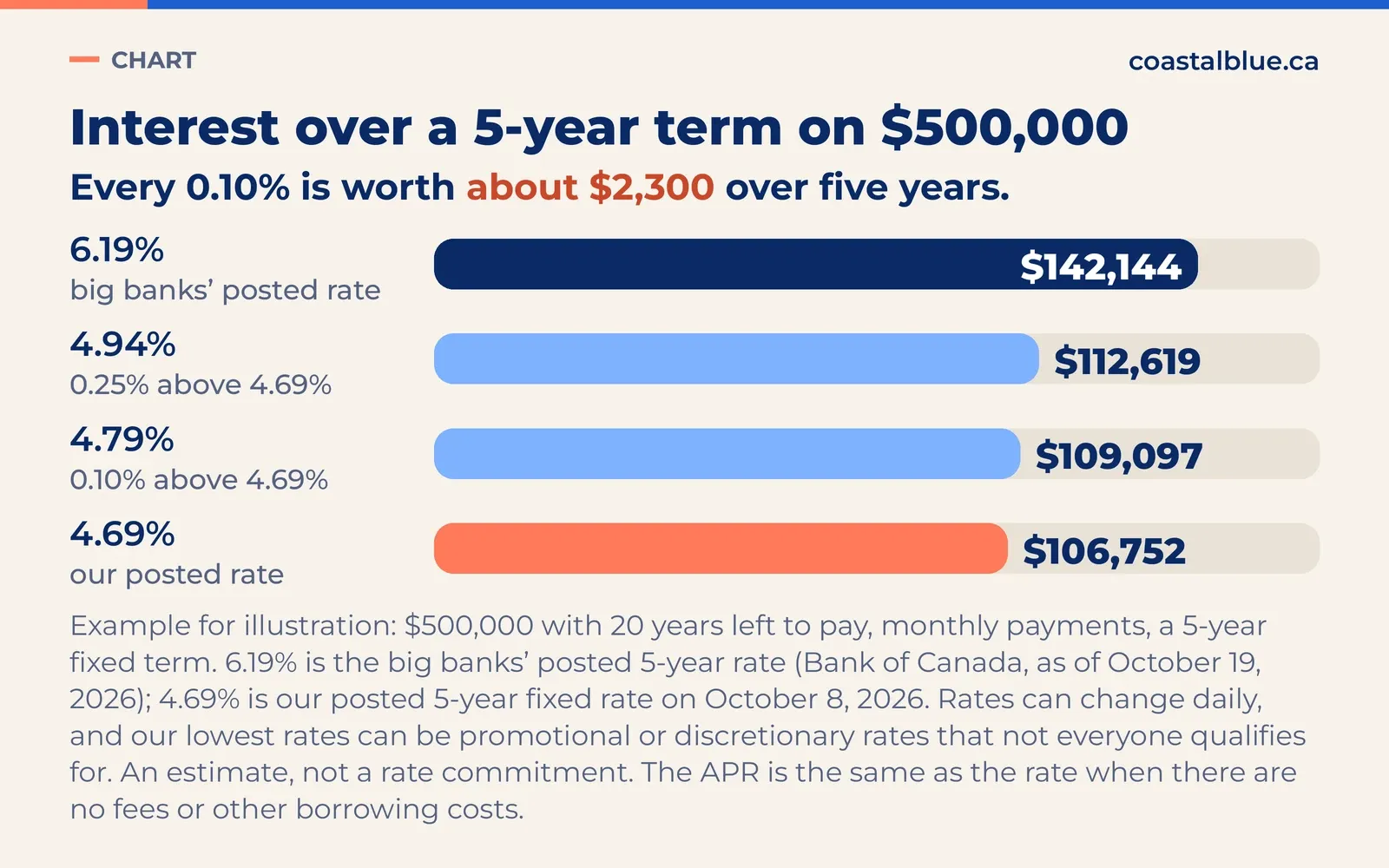
That's exactly the problem. A good renewal strategy starts before the letter arrives, because the letter is an opening offer, not the best one available. On a $500,000 balance, every 0.10% off your rate is worth about $2,300 over a five-year term.
This guide gives you the timeline, the math and your options: when to start, how rate holds and straight switches work, when penalties apply, and how to decide between renewing, switching, refinancing or blending.
2-Minute Summary
Start about four to six months before your maturity date. At banks and other federally regulated lenders, the renewal statement can arrive as little as 21 days before your term ends.
At maturity, you can renew, switch lenders or refinance without a prepayment penalty. Before it, breaking the mortgage usually costs one.
A straight switch (same balance, same remaining amortization) no longer needs the federal stress test when you move between federally regulated lenders.
A rate hold protects you while you compare. FCAC says lenders may hold a rate for 60 to 130 days, depending on the lender.
Small differences add up. On $500,000 over 20 years, 0.10% costs about $2,300 of interest over five years; a typical discharge fee runs from nothing to $400.
Refinancing at renewal (adding money or extending amortization) means requalifying at the stress-test rate.
Want your renewal options compared, with your own numbers?
When should I start my mortgage renewal?
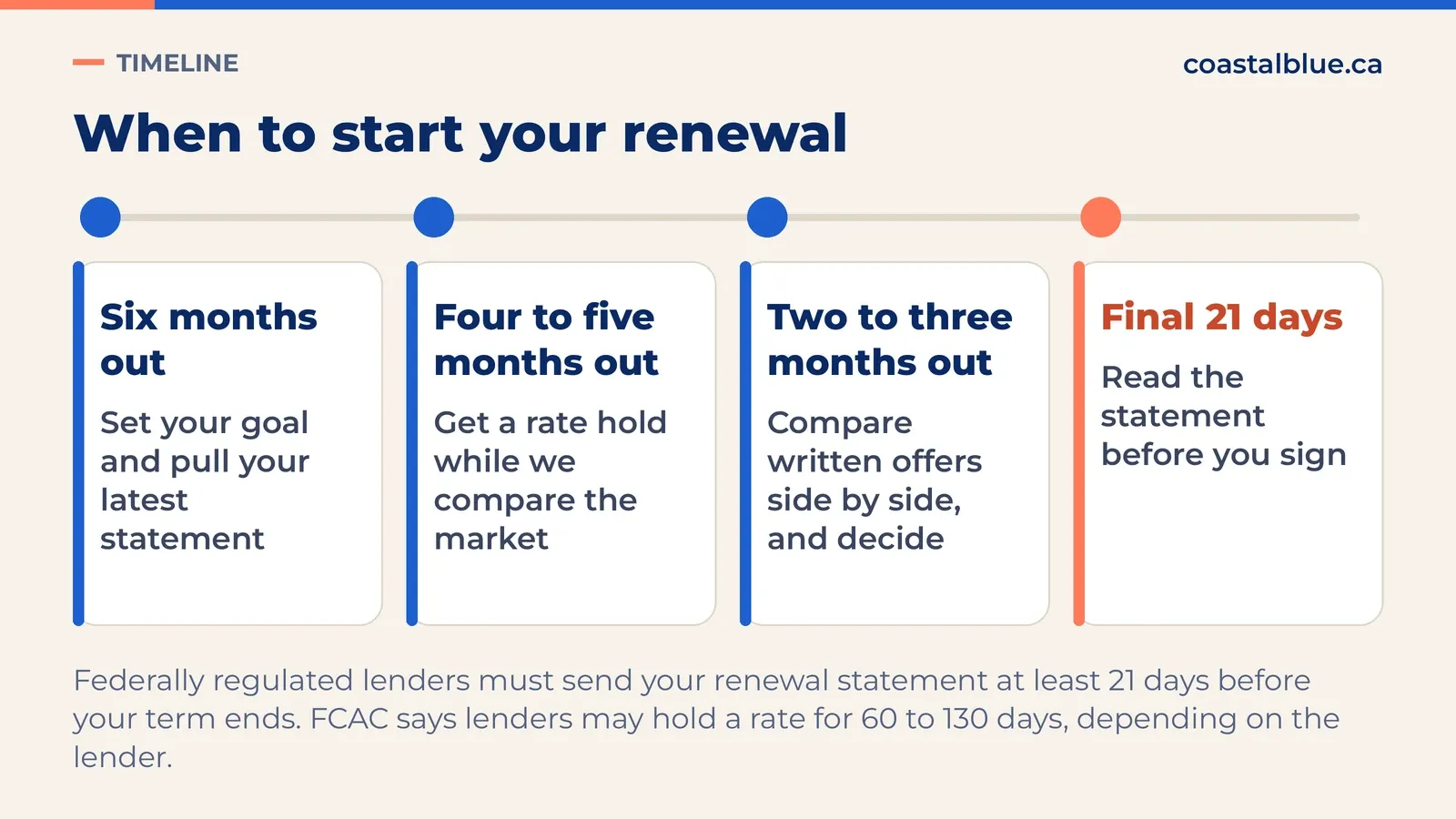
Earlier than your lender will remind you. Federally regulated lenders, such as banks, must send your renewal statement at least 21 days before your term ends. The voluntary Canadian Mortgage Charter asks lenders to reach out four to six months ahead, but you can't count on it.
Here's the timeline I use:
- Six months out: set your goal. Lower payment, faster payoff, cash for a renovation, or flexibility because you might move? The goal decides the path. Pull your latest statement: balance, rate, maturity date, remaining amortization and prepayment privileges.
- Four to five months out: get a rate hold. Send us your renewal letter, or your latest statement if the letter hasn't come yet, and we'll hold a rate while we compare the market. FCAC says lenders may hold a rate for 60 to 130 days, depending on the lender, so we make sure the hold covers your maturity date. Many lenders also let you renew early with them, without a penalty, in the last few months of your term. Check your own lender's window.
- Two to three months out: decide. Compare written offers side by side. If you're switching or refinancing, documents and an appraisal may be needed, so leave time.
- Final 21 days: read the statement before you sign. If you do nothing, your mortgage may renew automatically on your lender's terms. If your lender plans to renew it automatically, the renewal statement will say so.

Nick's Note
"Clients who start at 6+ months usually save more. We can capture dips with rate holds and avoid last-minute pressure."
What does a better renewal rate actually save?
The example: a $500,000 balance with 20 years left to pay, monthly payments, on a 5-year fixed term.
| Five-year fixed rate | Monthly payment | Interest over the 5-year term | Owing at the end of the term |
|---|---|---|---|
| 6.19% (the big banks' posted 5-year rate, Bank of Canada, as of October 19, 2026) | $3,614 | $142,144 | $425,277 |
| 4.94% (0.25% above 4.69%) | $3,269 | $112,619 | $416,453 |
| 4.79% (0.10% above 4.69%) | $3,229 | $109,097 | $415,347 |
| 4.69% (our posted 5-year fixed rate on October 8, 2026) | $3,202 | $106,752 | $414,604 |
These figures are estimates for illustration, not a rate commitment. Rates can change daily, our lowest rates can be promotional or discretionary rates that not everyone qualifies for, and yours depend on your lender and your file.
The posted rate is a bank's published rate, with no discount at all. Your renewal offer may be at or below it, which is why you compare.
Three decision rules fall out of this table:
- Every 0.10% on $500,000 is worth about $2,300 over five years. Scale it: on $250,000 it's about half that.
- A discharge fee rarely decides it. FCAC says lenders' discharge fees typically run from nothing to $400, and some new lenders cover the legal and appraisal costs of a straight switch. A 0.10% gap pays for a $400 fee several times over.
- Compare the whole offer, not just the rate. Prepayment privileges, the penalty method, portability and whether the mortgage is registered as a collateral charge can matter more than 0.05%.
Renew, switch, refinance or blend: which fits?
| Option | What changes | Do you requalify? | Typical costs | Best when |
|---|---|---|---|---|
| Renew with your lender | New rate and term, same lender | No | None | Your lender's offer is the best fit once compared with the market |
| Straight switch | New lender; same balance and remaining amortization | No federal stress test between federally regulated lenders; the new lender still approves you | Discharge fee; some new lenders cover legal and appraisal | Another lender's rate or terms are better |
| Refinance at renewal | Add money, change the amortization or a borrower | Yes, at the stress-test rate | Legal and appraisal; no penalty at maturity | Debt consolidation, renovations or payment relief |
| Blend-and-extend (before maturity) | Stay; old and new rates blended; term extended | Lender's own review | Possible admin fee; usually no separate penalty | Rates have dropped and your penalty to break is large |
| Break early to move | New mortgage mid-term | Yes | Penalty plus fees | Savings clearly beat the penalty and fees |
Choose by goal, not headline rate. Lowest cost with no changes: renew or switch, whichever comes out ahead when we compare. Cash flow relief or consolidating debt: refinance. Avoiding a big penalty mid-term: blend-and-extend. Likely to move in a year or two: a shorter term or a variable rate, with portability.
Nick's Note
*Port Moody, switch.* "Their lender offered 5.59% fixed. We switched them to a credit union at 5.34% with better prepayment privileges and no fee, saving about $1,900 in year one."
Nick's Note
*Surrey, refinance.* "This couple consolidated $45,000 of high-interest debt into the mortgage and extended the amortization to 30 years. Their total monthly payments dropped by about $780, which freed up the budget for daycare."
Refinancing lowers payments by stretching debt over more years, so you pay more interest overall. It's a tool for a cash-flow problem, not free money. More on that on our refinancing page.
Do I need to pass the stress test to switch lenders at renewal?
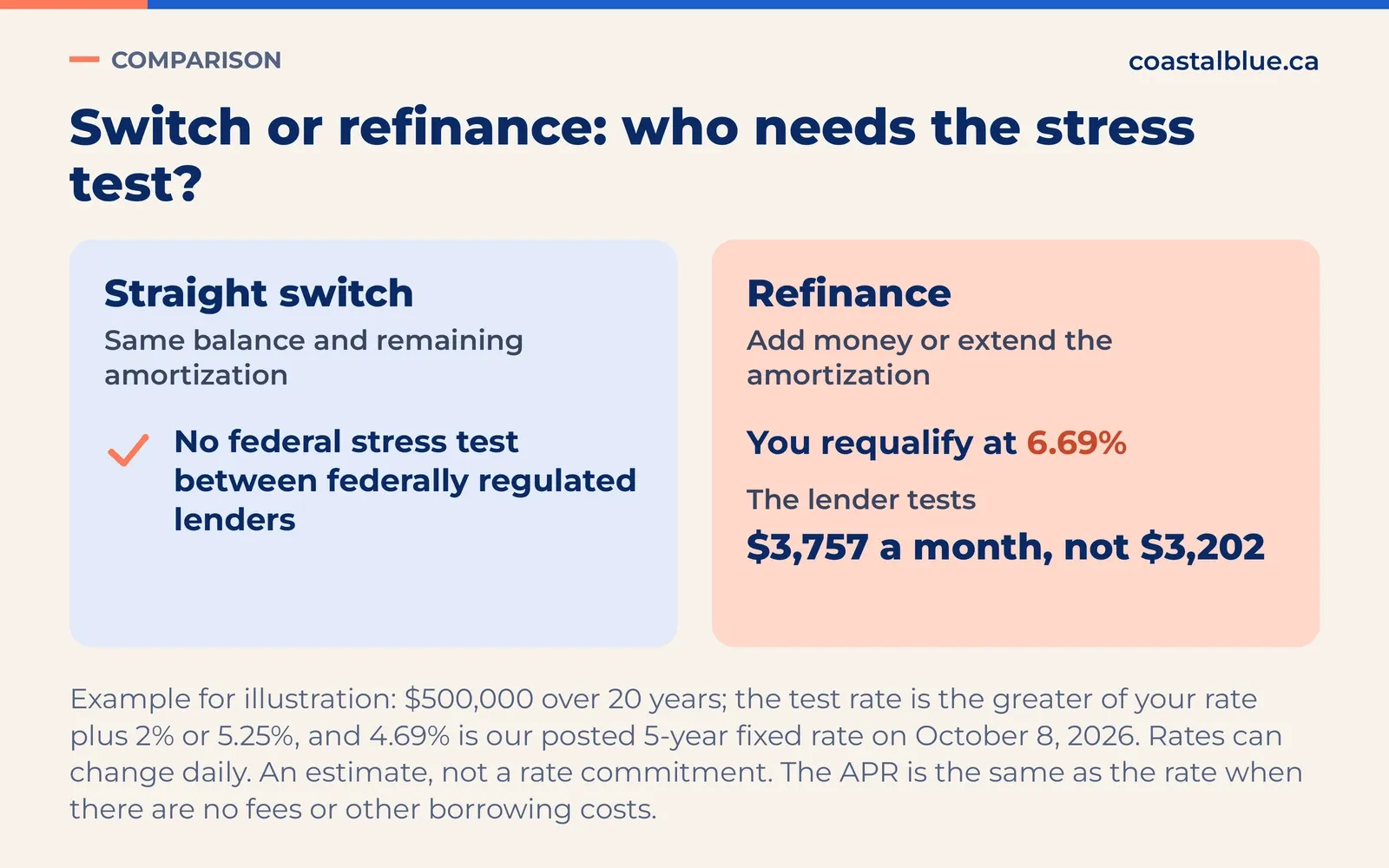
Not for a straight switch, in most cases:
- Uninsured mortgages: since November 21, 2024, OSFI no longer requires the minimum qualifying rate when you switch between federally regulated lenders at renewal, as long as the loan amount and remaining amortization don't increase.
- Insured mortgages (you put less than 20% down originally) can switch at renewal without requalifying at the stress-test rate.
- Low-ratio mortgages moving from a federally regulated lender to any lender that insures its portfolio got the same relief on December 16, 2024. The balance can rise by up to $3,000 to cover fees, but no equity take-out.
The new lender still reviews your credit, income and property, and sets its own rules.
The BC wrinkle: many BC credit unions are provincially regulated by BCFSA, not OSFI, so the federal exemption doesn't bind them. Some are great switch options; ask how each one qualifies a switch.
If you add money or extend the amortization, it's a refinance. You requalify at the greater of your rate plus 2% or 5.25%. At 4.69%, our posted 5-year fixed rate on October 8, 2026, that's 6.69%: on $500,000 over 20 years, the lender tests whether you can afford $3,757 a month, not $3,202.
Nick's Note
"At renewal you may not be insured-constrained. If payment relief matters, we can model a 30-year amortization on eligible files against a 25-year to compare cash flow."
How do mortgage penalties work if I move before my renewal date?
At maturity there's no penalty. Before it, there usually is. FCAC explains that most lenders charge the greater of:
- three months' interest, or
- the interest rate differential (IRD): the interest you'd pay at your rate for the rest of the term, minus the same at a comparison rate.
Variable-rate mortgages usually charge only three months' interest. The big catch with fixed rates is the comparison rate: many banks use their current posted rate minus the discount you got when you signed.
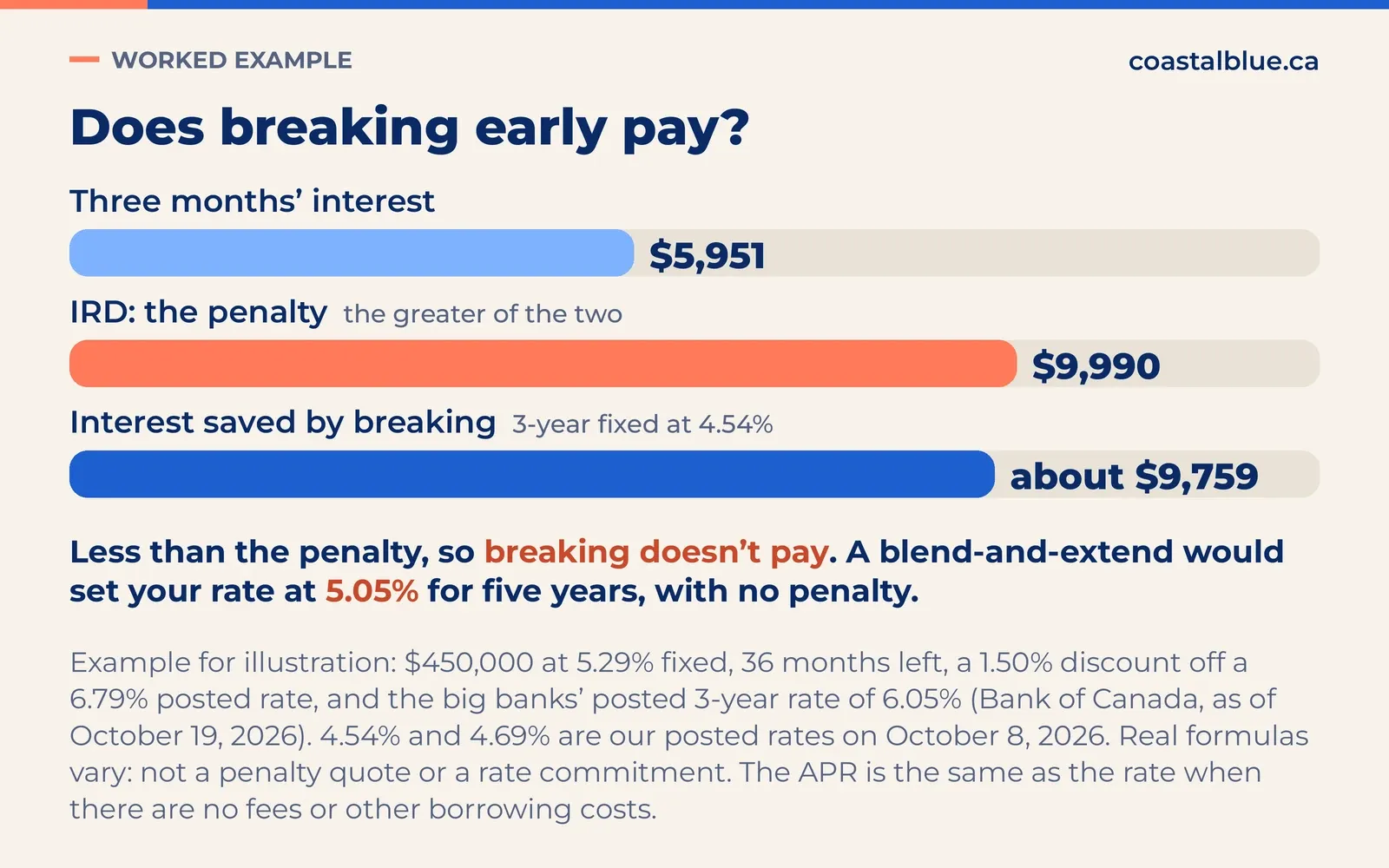
Example, for illustration: balance $450,000; 5-year fixed at 5.29%; 36 months left in the term and 22 years of amortization. Say the bank's posted rate was 6.79% when you signed, so your discount was 1.50%, and its 3-year posted rate is now 6.05% (the big banks' posted 3-year rate as of October 19, 2026, from the Bank of Canada).
- Three months' interest: $450,000 × 5.29% × 3 ÷ 12 = $5,951
- Comparison rate: 6.05% − 1.50% = 4.55%
- IRD: $450,000 × (5.29% − 4.55%) × 3 years = $9,990
- Penalty: the greater, $9,990, before any admin fee
If you broke to take a 3-year fixed at 4.54% (our posted rate on October 8, 2026), you'd save about $9,759 of interest over those 36 months. That's less than the penalty, so breaking doesn't pay. A blend-and-extend, using FCAC's simple method and, for illustration, 4.69% (our posted 5-year fixed rate on October 8, 2026) as the new rate, would set your rate at (5.29% × 36 + 4.69% × 24) ÷ 60 = 5.05% for five years, with no penalty. Or you could simply wait until your renewal window opens.
These are estimates for illustration, not a penalty quote or a rate commitment. Real formulas vary, and some lenders discount future interest. Always ask your lender for a written penalty quote, then check it with our Renewal Penalty & Rate-Hold Tracker.
Nick's Note
"The IRD surprises people. We'll calculate your lender's method before we recommend a move, and we'll contact your current lender to get a written penalty quote before any decision."
Nick's Note
*North Vancouver, blend-and-extend.* "The fixed-rate penalty (IRD) to break was about $9,800. We blended rates with the current lender and extended three years, which avoided the penalty and still improved cash flow."
How do I get the best renewal offer?
Your best move: send us your renewal letter early. We'll hold a rate, shop the market for you, and put your lender's offer side by side with the best we find.
- We hold a rate early. About four months before maturity, we can hold a rate for you with a new lender. If rates rise, you're protected. If they fall, we check whether you'd get the lower rate before closing.
- We check what you qualify for. FCAC notes you may qualify for a discounted rate lower than the one in your renewal letter, and its research found some mortgage holders didn't know negotiating was even an option. We check your letter against the market and do the negotiating for you.
- We shop lenders and compare the whole offer. Same term, same rate type, and the same features: the rate, prepayment privileges, penalty method, portability and the type of charge. If staying with your lender is the best fit, we'll tell you that too.
- We handle a straight switch. If another lender's offer is the better fit, we arrange the switch at maturity, with the same balance and remaining amortization.
- We check for a collateral charge. If your mortgage is registered as one, switching can cost more, and any other loans it secures must be paid out or moved too.
As a broker, we compare offers from more than 50 lenders. For a straight switch, our service is usually free to you, because the new lender pays us. If an option carries an application fee, as some credit union promotions do, we show you the full breakdown, fee included, before we suggest it.
What's different about renewing in BC?
- Lower prices can mean less equity. Greater Vancouver benchmark prices have been falling (see the box below). If you plan to refinance at renewal, get a realistic value first, because most lenders refinance only up to 80% of the home's value.
- Credit unions play by provincial rules. As above, ask each BC credit union how it treats a switch.
- Lawyers or notaries handle the paperwork. In BC, a lawyer or notary public registers the new mortgage at the Land Title Office and discharges the old one. On a straight switch, some new lenders cover that cost.
What's true as of Q4 2026
- Our posted rates on November 21, 2026: 5-year fixed 4.64%, 3-year fixed 4.79%, variable 3.70% (prime minus 1.00%, with the big-bank prime rate at 4.70%).
- The examples in this guide use our posted rates on October 8, 2026, for illustration: 5-year fixed 4.69%, 3-year fixed 4.54%.
- The big banks' posted rates (Bank of Canada, the latest weekly figures as of November 22, 2026): 1-year 5.49%, 3-year 6.05%, 5-year 6.19%. Lenders that use posted rates in their IRD formulas start from figures like these.
- Stress test: the higher of your contract rate plus 2% or 5.25% (OSFI).
- Straight switches: uninsured switches between federally regulated lenders have been exempt from OSFI's qualifying rate since November 21, 2024. Insured switches are exempt too. Low-ratio, portfolio-insured switches to any lender have been exempt since December 16, 2024, with up to $3,000 added for fees.
- Renewal statement: at least 21 days before maturity at federally regulated lenders.
- Renewal pressure (Bank of Canada Financial Stability Report, May 2026): over the 12 months after the report, the last of the five-year, fixed-payment mortgages taken out during the pandemic renew. They're about 12% of all outstanding mortgages in Canada, and their payments rise about 15% on average.
- BC market: the Greater Vancouver Realtors composite benchmark price was $1,075,900 in September 2026, down 5.5% year over year.
Checked November 22, 2026. Our posted rates are estimates, not a rate commitment: rates can change daily, our lowest rates can be promotional or discretionary rates that not everyone qualifies for, and the rate you're offered depends on your file.
Frequently Asked Questions
You Have Questions — We Have Answers!
How early can I renew my mortgage without a penalty?
It depends on your lender. Many lenders let you renew early with them, without a prepayment penalty, in the last few months of your term, often from about 120 days before maturity. Check your mortgage contract or ask. Renewing earlier than that usually means a penalty or a blend-and-extend, where your old and new rates are averaged and your term is extended instead.
Do I have to pass the stress test to switch lenders at renewal?
Usually not for a straight switch. Since November 21, 2024, federally regulated lenders don't have to apply the minimum qualifying rate to an uninsured mortgage that switches between them without adding money or amortization. Insured mortgages can also switch without requalifying. The new lender still reviews your application, and provincially regulated BC credit unions set their own rules.
What happens if I don't respond to my renewal letter?
Your mortgage may renew automatically on the terms in the letter, which may not be the best rate available. Federally regulated lenders must send the renewal statement at least 21 days before your term ends, and if your lender plans to renew automatically, the statement will say so. Starting four to six months early gives you time to compare written offers instead.
Does it cost anything to switch lenders at renewal?
Usually little. FCAC says lenders' discharge fees typically range from nothing to $400, and some new lenders cover the legal and appraisal costs of a straight switch. It costs more if your mortgage is registered as a collateral charge, or if you're switching before maturity and owe a prepayment penalty. Get every fee in writing before you decide.
Can I add money or extend my amortization when I renew?
Yes, but that's a refinance, not a renewal. You'll requalify at the stress-test rate, and most lenders refinance only up to 80% of your home's value. There's no prepayment penalty at maturity, though legal and appraisal costs may apply. Stretching the amortization lowers your payment but increases the total interest you pay.
Is my lender's renewal offer the best I can get?
Not always. FCAC notes you may qualify for a lower rate than the one in your renewal letter. Send us your letter early, and we'll hold a rate, compare your lender's offer with the market and do the negotiating for you. If another lender is the better fit, a straight switch at maturity carries no prepayment penalty, and we compare the full terms, including prepayment privileges and penalty method, not just the rate.
Key takeaways
Start four to six months before maturity; the 21-day renewal statement is a deadline, not a plan.
On $500,000, every 0.10% is worth about $2,300 over five years. Send us your renewal letter early, and we'll compare it with the market for you.
Straight switches no longer need the federal stress test between federally regulated lenders; adding money or amortization does.
Before maturity, get a written penalty quote and compare it with the savings, a blend-and-extend, or simply waiting.
Your next step
Renewing more than four months from now? Set a renewal reminder. Tell us your renewal date and we'll remind you about four months ahead, when it's time to compare offers and lock a rate hold.
Already have your renewal letter? Send it for a free renewal review, and we'll show you how your lender's offer compares. Or apply, and I'll line up your lender's offer against the market.
The application doesn't commit you to anything. If you'd rather talk it through first, book a call.
Also Read:The Stress Test: How It Actually Limits Your Budget in BC. →
Also Read:Fixed vs Variable in BC: Which Mortgage Fits Your Risk Profile? →
Companion resource
Mortgage Renewal Readiness Worksheet
My current mortgage
- Lender: ________ Maturity date: ________
- Balance at maturity: $________ Remaining amortization: ____ years
- Current rate and type (fixed or variable): ____%, ________
- Is it registered as a standard or collateral charge? ________
- My lender's early-renewal window (days before maturity): ____
- Prepayment privileges I haven't used (lump sum, payment increase): ________
My goal
- Pick one: lowest cost with no changes, a lower payment, cash out for a renovation or debt, or flexibility because I may move.
Offers (get each in writing)
- Renewal letter: rate ____%, term ____, features ________
- Offer 2: lender ________, rate ____%, term ____, rate hold until ________
- Offer 3: lender ________, rate ____%, term ____, rate hold until ________
- Gap between best offer and renewal letter: ____% ÷ 0.10 × $2,300 × (my balance ÷ $500,000) ≈ $________ over five years
Costs and penalties
- Discharge fee: $________ Legal and appraisal covered by the new lender? Yes / No
- If moving before maturity: written penalty quote $________ (three months' interest or IRD)
- Blend-and-extend rate offered: ____% (compare with the penalty)
Documents ready
- Photo ID and latest mortgage statement
- Income proof (recent pay stubs and T4, or two years of T1s and Notices of Assessment if self-employed)
- Property tax notice, home insurance details, and strata documents if a condo or townhouse
- Credit check: card balances low and every payment on time in the months before renewal
Dates
- Reminder set four months before maturity
- Decision deadline (at least 30 days before maturity): ________
Download The Worksheet (PDF)
Sources
- Financial Consumer Agency of Canada, Renewing your mortgage. Supports: renewal statement at least 21 days before the term ends at federally regulated lenders; the statement says so if your lender plans to renew automatically; you can move to another lender; you may qualify for a discounted rate lower than the one in your renewal letter; start comparing a few months early.
- Financial Consumer Agency of Canada, Canadian Mortgage Charter briefing (May 31, 2024). Supports: lenders are asked to contact borrowers four to six months before renewal; the Charter isn't legislation.
- OSFI, OSFI exempts uninsured mortgage straight switches from the prescribed MQR and implements portfolio LTI limits. Supports: exemption from November 21, 2024; no increase in amount or amortization; between federally regulated lenders.
- OSFI, Minimum qualifying rate for uninsured mortgages. Supports: the greater of contract rate + 2% or 5.25%.
- Department of Finance Canada, Government announces boldest mortgage reforms in decades (September 2024). Supports: insured mortgage holders can switch at renewal without another stress test.
- Department of Finance Canada, "Straight Switches" and portfolio insurance (December 2024). Supports: low-ratio switches from December 16, 2024; $3,000 allowance for costs; no equity take-out.
- Financial Consumer Agency of Canada, Mortgage fees: Prepayment penalties. Supports: usually the greater of three months' interest or the IRD; variable rates usually three months' interest; the comparison rate can be a posted rate minus your original discount.
- Financial Consumer Agency of Canada, Breaking your mortgage contract. Supports: the blend-and-extend method; fees for breaking; collateral charges.
- Financial Consumer Agency of Canada, Exploring consumer behaviour in mortgage renewal decisions (research data story). Supports: some mortgage holders didn't know negotiating rates or terms was an option.
- Financial Consumer Agency of Canada, Discharging a mortgage. Supports: lenders' discharge fees typically from no charge up to $400.
- Financial Consumer Agency of Canada, Getting preapproved for a mortgage. Supports: lenders may hold a rate for 60 to 130 days, depending on the lender.
- Financial Consumer Agency of Canada, Borrowing against home equity. Supports: most lenders refinance up to 80% of the home's value.
- TD, Mortgage renewal 101. Supports: an example of a lender that lets you renew early, without a prepayment charge, from 120 days before maturity.
- Bank of Canada, Posted interest rates offered by chartered banks. Supports: big-bank posted 1-, 3- and 5-year rates (5.49%, 6.05%, 6.19%), the latest weekly figures as of October 19, 2026, and unchanged as of November 22, 2026.
- Bank of Canada, Financial Stability Report 2026: Households (May 2026). Supports: the last pandemic-era five-year fixed-payment mortgages, about 12% of outstanding mortgages, renew over the following 12 months, with payments up about 15% on average.
- Greater Vancouver Realtors, Residential Market Report, September 2026. Supports: composite benchmark $1,075,900, down 5.5% year over year.
- BCFSA, Residential Mortgage Underwriting Guideline for BC credit unions. Supports: BC credit unions are provincially regulated and follow BCFSA's underwriting guidance.
- Coastal Blue Mortgages, our posted rates on October 8 and November 21, 2026, as shown on our mortgage rates page. Supports: the illustrative rates in the examples (October 8: 5-year fixed 4.69%, 3-year fixed 4.54%) and the posted rates in the "What's true" box (November 21: 5-year fixed 4.64%, 3-year fixed 4.79%, variable 3.70%, prime 4.70%). Not an official source; used only for "for illustration" rates and the box.
- Payment, interest, balance and penalty figures: computed with semi-annual compounding (monthly rate = (1 + r/2)^(1/6) − 1) and the three-months'-interest and IRD formulas shown in the example, the same method as our calculators, with the inputs stated in each example.

Written by: Nick Atwal
Mortgage Broker at Coastal Blue Mortgages
BCFSA licence 504576
Top 5% of Dominion Lending Centres brokers in Canada, 2022Canadian Mortgage Professional Rising Star, 2023
Nick Atwal is a mortgage broker at Coastal Blue Mortgages, helping families and business owners with complex structuring and refinancing solutions. Recognized as one of Canada’s rising young mortgage professionals by Canadian Mortgage Professional, he focuses on thoughtful planning, clear communication, and long-term financial outcomes.
More about NickTry it with your numbers
A quick estimate at today's 5-year fixed rate, with mortgage insurance and Canadian semi-annual compounding built in.
Monthly payment, 25 years at 4.64%
$4,167
Includes $22,320 mortgage insurance (3.10%) added to the mortgage.
Rates as of Nov 22, 2026. The low end can be a promotional or discretionary rate that not everyone qualifies for. Rates can change daily, and your rate depends on the lender approving your full application, so these are estimates, not a rate commitment.
Set a renewal reminder